Tuesday, May 26, 2009

Holly Lane Antiques At The Topsfield Antiques Market


Holly Lane Antiques began its summer round of East Coast Antiques Shows at the Topsfield Antiques Market in Topsfield Massachusetts Memorial Day weekend.


A large collection of Early English White Ironstone was the main feature in our booth. Many special pieces recently purchased at the White Ironstone China Association convention were included in this collection.


Early transferware pieces especially in blue and white are always a favorite among buyers.


Quilts, Lovely English Table Linens, Vintage Silver and Glass, Tole Trays and Furniture completed our booth.


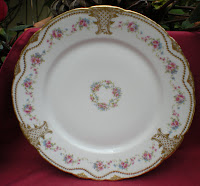
As always we included a selection of our vast collection of Antique Haviland Limoges China along with other very special antique china pieces.


The weather was typical New England with the temperature ranging from 90 one day to 60 the next combined with a Sunday afternoon thunder shower that had all of us dealers scampering to pull everything back into our tents.

Our next show will be the new SoWa Antiques Market which continues every Sunday through October. This market is located in an old trolley barn in Boston's SoWa Arts district of the South End. Holly Lane Antiques is scheduled to be there May 31 and June 14 and then later in the summer. For directions to the SoWa Antiques Market please visit this website www.sowaantiques.com

We would love to meet our internet followers. If you are in the area of our shows please stop by our booth.

If not - remember that many of the items you see pictured are available on line.

(Click on the banner to visit Holly Lane Antiques Internet Store)

Friday, May 8, 2009

White! White! White!

Holly Lane Antiques spent last weekend at the WICA ( White Ironstone China Association ) convention in Chautaugua New York. We loved every minute spent surrounded with wonderful Antique White Ironstone and all the nice people who are also addicted to it. We purchased many special pieces of Early English White Ironstone at the auction and sale. Some of these will become part of our private collection but many of them will be available beginning today at our Antique Arts store - http://www.antiquearts.com/13609/InventoryPage/1954821/1.html.

Our purchases include teapots such as this Lion's Head Shape by John Edwards


and this Walled Octagon Shape by Jacob Furnival


We also purchased many pitchers and ewers in a variety of sizes. We are especially fond of pitchers and ewers. This Vintage Shape By E Challinor features embossed vines and grapes.


The Scalloped Decagon by Davenport has a wonderful classic shape.


As does this Grape Octagon Shape ewer. These classic lines are a favorite among the traditionalists.


I continue to favor those with floral embossing such as this Fuschia Shape ewer by Meakin.


One of my favorites from the convention is this brush box in the Pear Shape by Henry Alcock. The finial is most special!


Click on the pictures to be taken directly to the store pages and for more details.

(Click on the banner to visit Holly Lane Antiques Internet Store)

Monday, April 20, 2009

Identifying Antique Haviland Limoges Patterns - lll -


Continuing with Antique Haviland Limoges China Pattern Identification -

As mentioned previously, the best and most complete source for Haviland Limoges pattern identification are Arlene Schleiger's books. These books are divided into sections based on the back marks mentioned in an earlier blog. Once you have identified the Haviland maker you know which section in these books to look for your pattern. The main problem with Ms Schleiger's books is that the pictures are in black and white. Most were drawn from a saucer or small plate.


Look very closely at the pattern you wish to identify - preferably on a saucer or small plate if available. Is it a border design or is it scattered all over the piece? Try to imagine it in black and white.


Observe what it is that makes this design unique. This could be the shape of the flower - but since so many are roses this may not be the best starting point. Many patterns have other flowers mixed with the roses - concentrate on them.


Be aware of the placement of the flowers in the pattern - do they loop, are they garlands, do some of the flowers drop to the center of the plate?


The shape of the leaf is often distinctive.


The addition of ribbons, scrolls or lattices amongst the flowers is perhaps the most helpful in narrowing the pattern identification.


Once the pattern is identified with its Schleiger number, most often there are many variations of that pattern. These variations may be in the color of the design, the shape of the blank, the gold trim or lack of it. Sometimes it takes many trips through all of the books to identify a Haviland pattern.


Needless to say, identifying an Antique Haviland Limoges China Pattern can be most time consuming and often quite frustrating. When it is successful it is indeed an accomplishment!


It is always encouraging to verify an identification by looking at the color pictures in Nora Travis books on Haviland China. These books have lovely pictures of many patterns but are not complete identification guides.


Click on the pictures to be taken directly to their store pages and for specific pattern identification.

(Click on the banner to visit Holly Lane Antiques Internet Store)

Wednesday, April 15, 2009

Theodore Haviland - Romeo Blank With Gold Trim - Schleiger 304 -


A favorite among Haviland China lovers is the Romeo Blank with double gold trim - identified by Arlene Schleiger as Schleiger 304.

The blank is the piece of china before it is decorated - the white ware - with its shape and embossing defined. The Romeo Blank - Schleiger 300 - is gently scalloped with some rim embossing. However, this blank really comes into its own with the variation - Schleiger 304 - with the double gold trim.


Many of the patterns found on this particular blank are very similar with patterns of small pink roses or other flowers. These patterns are often combined to create a wonderful table setting with the primary unifying aspect being the Romeo Blank and secondarily the pink color. In fact, most often these types of combined table settings have a much more special effect than a table with the china all identical. Looking at the pictures presented here one can easily imagine such a table setting.


Many pieces of Antique Haviland Limoges China on the Romeo Blank are available for purchase at Holly Lane Antiques. Click on the pictures to be taken directly to their store pages and for specific pattern identification.

(Click on the banner to visit Holly Lane Antiques Internet Store)

Saturday, April 11, 2009

Identifying Antique Haviland Limoges Patterns - ll -


Where do I begin my pattern identification?

First of all I look at the back mark. With the following knowledge - which may be considered over simplification - I can identify most of the Antique Haviland China that I come in contact with. On a rare occasion I need to turn to my reference books for an unusual mark.

The 4 found most often are variations of the following -


1) The H & Co back mark. This is one of the oldest Haviland & Company marks dating to the late 1800's. Variations of the H & Co stamp are found and some date as early as the 1860's.

There are 2 marks on the back of Antique Haviland china - one represents the manufacturer and the other represents the decorator. If there is just one mark the china was sold as whiteware and usually decorated elsewhere. Sometimes there is also a mark representing the store the china was produced for.


2) The Haviland France back mark. This mark is the one most often found and dates to c.1894-1931. This was the period during which most Haviland china was sold. Again these marks are also found combined with store marks. Also the rarely found patterns that were named and identified by Haviland appear with these back marks.


3) The Theodore Haviland mark. This commonly found mark and its variations date from 1893 to the early 1900's. Theodore was the son of David Haviland. He dissolved his partnership with his brother and set up his own company. His pieces at first had only an impressed TH mark later to include the marks shown. These back marks also sometimes include store names. If a store ordered a certain amount of china the store name was included as part of the back mark. Sometimes an exclusive variation (a special border or gold trim) of a pattern was made for a particular store.


4) The Charles Field Haviland mark. Charles F Haviland was the nephew of David Haviland and opened his own company in the late 1800's in competition with his uncle's Haviland & Company. Later Charles joined with GDM ( Gerard, Dufraisseix and Morel). A back mark in combination with GDA is often found.


Arlene Schleiger divided her books into sections according to these manufacturers - Haviland & Company, Theodore Haviland, Charles F Haviland.

Continuing the process of Identifying Antique Haviland Limoges China - watch for future blogs.

A large collection of Antique Haviland Limoges China is available for purchase at Holly Lane Antiques.
(Click on the banner to visit Holly Lane Antiques Internet Store)